

Faculty of
Architecture

Faculty of
Planning
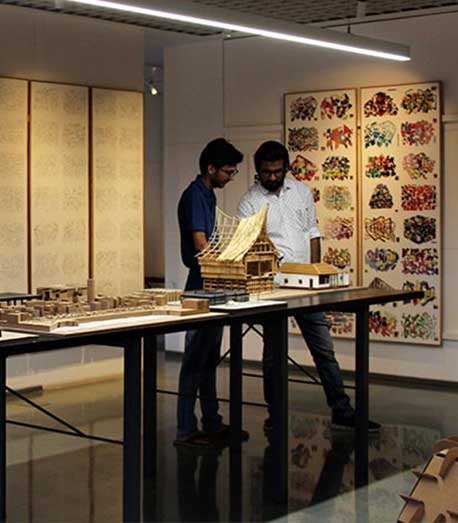
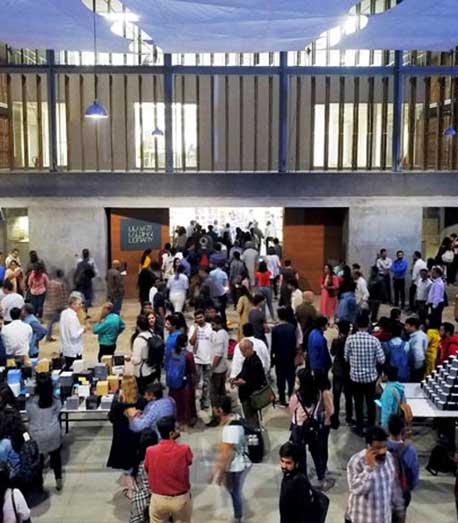
CEPT University focuses on understanding, designing, planning, constructing and managing human habitats. Its teaching programs aim to build thoughtful professionals and its research programs deepen understanding of human settlements. CEPT University also undertakes advisory projects to further the goal of making habitats more liveable. Through its education, research and advisory activities, CEPT strives to improve the impact of habitat professions in enriching the lives of people in India's villages, towns and cities.
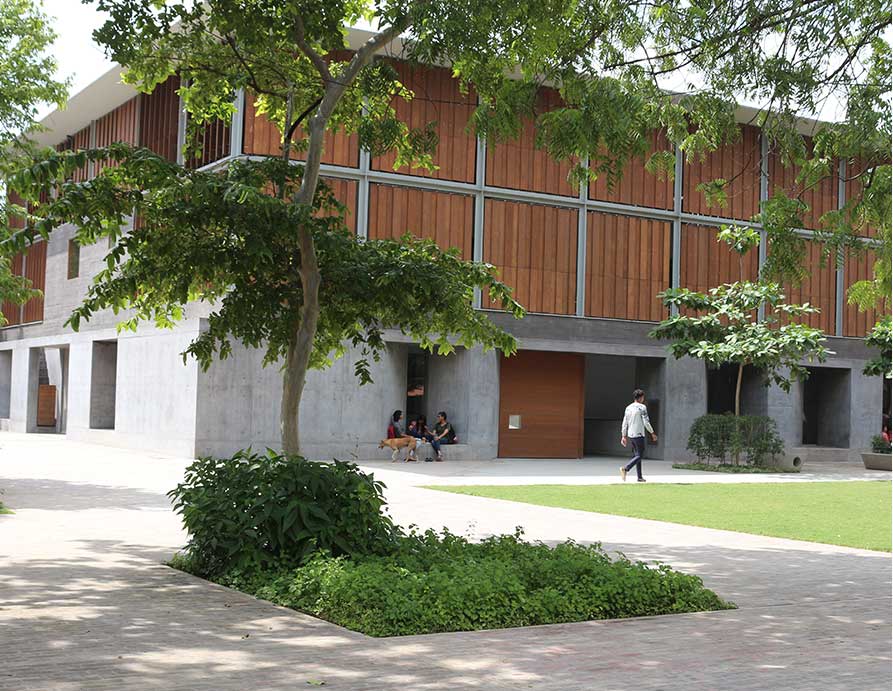

The program offers student-architects the means to use their knowledge and insight to better respond to expanding the field of architecture and design in meaningful ways.
Studios in this stream are offered by a range of academic and practicing architects, providing for a balance of practice oriented and theoretical explorations. CEPT's tradition of intensive creative pedagogy underpins the studios in this specialization as it does in the other streams. These studios are further supported by a range of courses that introduce students to paradigms of advanced design thinking on the one hand and specialist tools and techniques through an exposure to the CEPT FabLab, Workshops and CARBSE centre on campus on the other.
The program situates itself in the context of the World Heritage Site of Historic City of Ahmedabad and engages with the historic built environments, urban histories and theories, contextual design approaches and community engagement to explore the relationship between conservation practice and urban regeneration.
Building on the long history of research at CEPT, students in this program engage with analysing built environments in relation to aesthetic, technological, social, and political perspectives. The program aims:
There is a distinct opening up of professional opportunities through the expansion of publishing, new curatorial platforms, emerging heritage concerns, and rapidly expanding education sector, highlighting the need for a new generation of critical-creative architectural historians and theoreticians. Responding to these developments, the Faculty of Architecture at CEPT University offers India’s only dedicated program on architectural history and theory.
The landscape program at CEPT University is designed to allow a comprehensive and in depth understanding of the profession. It provides professional education to develop landscapes in dense built environments and master plans through intense design education supported with strong engineering foundation. Students have demonstrated new thinking, coupled with measured and relevant responses to varying landscape situations. The spirit of exploration and finding creative solutions is a part of the education. The underpinning principle is an emphasis on design of landscapes towards development and conservation of natural sustainable ecosystems.
The Master’s in Interior Design program is an interdisciplinary design-led and research informed programme examining the practical and theoretical discourses in the field of interior design. The Master of Design in Interior Design course at the Faculty of Design is established to realize the need for design, research, innovation, and experimentation in the field of interior design. The opportunity is to create and innovate in a global economy, drawing from our own resource pool of extremely rich, pluralistic, multi-polar and challenging Indian context.
The M. Des. (Furniture Design) program is a pragmatic response to the growing needs of the furniture industry and of the market. Today, the rate of development in all Indian Metros is exponential in nearly all sectors. The demand for furniture follows on from there in the residential, commercial and institutional sectors. Currently, a large percentage of furniture supplied to the market comes from abroad and could as easily be designed and made in India.
Master’s in Building Products and Systems synthesizes a cross-disciplinary and cross-cultural approach with strong emphasis on the hands-on experimentation working in collaboration with emergent technologies and industrial partnerships. The goal of this program is to provide future product designers with thorough knowledge and skills in the field of industrial design: specifically, the design of products which are part of built spaces. The program builds on the human–centered design approach to problem-solving, starting with the people one is designing for and ends with new creative solutions balancing aesthetics, product performance, sustainability and ease of manufacturing.
This cross disciplinary course aims to amalgamate building design solutions with the emergent technologies. Products and systems that are imported today are unsuited to the Indian context. Use of appropriate technologies and details can elevate our building practices to a global level and provide us with indigenous solutions that are better oriented to our way of living, cost effective and readily available.
Construction managers play a crucial role in the development of built environment and infrastructure. They facilitate the process of construction planning, and ensure efficient and timely implementation of infrastructure projects. CEPT University offers a two-year full-time post-graduate program leading to Master’s in Construction Engineering & Management. This program aims to train engineers and architects to become competent professionals in the field of construction engineering and project management. The teaching programs at CEPT University focus on building professional capacities. Therefore, they are centered on studio based pedagogy, which is inclusive of simulation of real life projects (buildings, infrastructure etc.). Coursework, seminars and research assignments, aimed at developing conceptual and analytical abilities of students, and skill-enhancing workshops support learning in studios and labs.
The Master’s in Structural Engineering Design two-year program. The Structural Engineering Design program at CEPT University is a pioneering program that offers studio pedagogy wherein live projects under various categories are solved, designed and detailed by students under the guidance of faculty members. The range of structures designed by students include low and high rise residential and commercial buildings, bridges, water tanks, industrial structures such as chimneys, silos and marine structures. The program faculty comprises highly educated core faculty members and eminent visiting faculty members. The graduates of this program are either placed at leading consulting firms or have also started their own practice.
Master’s in Geomatics is a multi-disciplinary professional course wherein advanced subjects like Remote Sensing, GIS, Database Management Systems, Spatial Data analysis, Programming languages, Photogrammetry, GPS and Location Based Systems, LiDAR, Big-data, Web and Mobile GIS, Open Source technologies, Project Planning and Geo-visualization are taught. It gives a unique opportunity to explore the wide applications in multidisciplinary fields of Engineering, Construction, Infrastructure, Utilities, Planning, Management, Information Technology and Governance.
Master's in Building Energy Performance has been recognized internationally through awards and student placements. The students get the benefit of our background in high quality research and practical experience with energy efficiency and net-zero energy buildings. CEPT University’s focus on design and management of human habitat provides a supportive eco-system for learning about building energy performance. Our faculty consists of industry experts, experienced practitioners and researchers who have a solution oriented approach. We have a world-class research facility that houses the latest equipment for testing and measuring thermal and luminous effects in buildings.
Master’s in Urban Management program aspires to create a pool of high quality professionals with skills to lead organizations which manage human habitats. The program focuses on management of urban systems and services and their improvement. Students are exposed to the management tools required in both private and public built spaces. The course facilitates students to develop skills to address complex problems like enhancing long term efficiency of urban services, improving day-to-day functioning of cities and finding ways to improve financing of urban systems.
Planning a city or an urban area is a challenging yet rewarding task, especially for those who are interested in transforming and improving our cities. It requires multi-layered understanding of the factors that influence the places where we live, work and use. Master of Urban Planning (MUP) allows students’ exposure to national and international best-practices in urban planning and equips them with knowledge and skills necessary for their professional careers in planning and managing growth and development of urban areas, cities and regions.
During the course, students learn to understand and analyse variety of factors influencing our cities and apply critical thinking in providing integrated, interdisciplinary solutions. Through hands-on studio exercises, theory courses, individual research projects and field visits within India and abroad. The course equips students with thorough knowledge of preparing statutory plans, and other plans ranging from regional to city and local area levels.
Master of Urban Transport Systems aims to provide holistic knowledge on planning, technology, design, operations and management of urban transport, besides developing skill sets related to transport system analysis and application of various policy instruments. The programme will combine theoretical analysis with practical applications to help students understand how to deal with transport problems in the real world. The focus is to enable students to comprehend the complexities of urban transport and develop their capacities to shape the future of transport in cities.
The two-years Master’s Degree Program in Urban Infrastructure (MUI) and MUI (major in WASH) prepares young professionals for career in one or many of these: (i) preparing infrastructure projects for the cities and their regions, (ii) undertaking research on policies and processes of urbanization and urban infrastructure development, (iii)advising on governance of infrastructure projects and facilities in cities and their regions, and (iv) preparing projects and overseeing their execution in the areas of urban infrastructure in India as well as other developing countries. It also exposes the students to environmental, social, political, economic and financial dimensions of urban infrastructure development and ethical dimensions of working as a professional.
Infrastructure Planning offers studios on preparing infrastructure plans at city level and infrastructure project development. Studios also explore interdependence between urban development and regional infrastructure facilities like Airports, Ports, SEZ etc.
Master of Urban Housing aims to provide applied knowledge about local housing market, policy making, planning, design and technology aspects of urban housing and project formulation and monitoring, design and technology aspects of urban housing. The programme will impart generic knowledge related to urban habitat, knowledge related to housing domain and tools and techniques required to analyse and apply solutions to urban housing related problems. The students are trained to engage with scales from local projects to city, region and global through studio courses, theory courses, hands-on tutorials, individual capstone projects and technical guided field visits in India and abroad during summer and winter schools. The programme offers studios on preparing Housing strategy at city level and housing project development within different submarkets.
As there is a growing interest in improving quality of our cities, there is an urgent need for professionals who can imagine and improve the everyday urban life of the urban dwellers through better design of the physical environment. MUD programme pedagogy reciprocates this dynamic urban scenario in preparing design professionals equipped to take on this urban challenge.
Design studios are at the centre of the MUD programme which engages multiple design topics that cut across a variety of scales and urban scenarios. The studio exercises are structured around real-life projects emerging from the public discourse within a given city. These projects will be predominantly concerned with the design of new neighborhoods, urban regeneration, and design of public places.






























CEPT University, Kasturbhai Lalbhai Campus, University Road, Navrangpura, Ahmedabad - 380009, India
Email : admissions@cept.ac.in, Toll-free number 1800 - 240 - 4030